

Special Online Micro/Nano Seminar Series 2026
Next Seminar:
Pulsed Laser Interferometry Measurements at mmWave Frequencies and Microwave Acoustic Resonators in Optomechanical Systems and Beyond
Wednesday, April 15, 2026, 2:00 PM Central Time
Hosted by ASPE Micro/Nano Committee, Chairman: Michael Cullinan, UT Austin (michael.cullinan@austin.utexas.edu)
Speaker: Liam G. Connolly, National Institute of Standards and Technology & Johns Hopkins University
Abstract:
One of the principal challenges in designing and applying microelectromechanical system (MEMS) based acoustic resonator devices to a variety of areas, from high overtone bulk acoustic resonators (HBARs) to surface acoustic wave (SAW) designs, has revolved around the difficulty in measuring and visualizing the acoustic response of these devices at high frequencies where electrical response only tells half the tale. Commercially available systems like laser vibrometers and holographic microscopes are typically limited to a maximum frequency of a few GHz for out-of-plane modes and typically don’t have spot sizes or spatial resolutions fine enough to resolve surface acoustic waves with sub-micron wavelengths. With our pulsed laser homodyne interferometer, however, we can measure well above 10 GHz and, using a UV laser system, resolve spatial acoustic waves below 500 nm in wavelength all with a sensitivity
of less than 30 fm/√Hz.
One device design in particular, the HBAR, can be integrated with optical microcavities towards the goal of microwave-to-optical frequency conversion for quantum communications. In this scheme, microwave photons are used to electromechanically excite a (HBAR) through a piezoelectric transducer. This resonance results in sidebands on the cavity pump laser at a spacing equal to the mechanical resonance frequency, optomechanically transducing the signal from the microwave domain to the optical domain. Moreover, through applications of RF frequency combs to device readout, high-speed measurement of resonances with sub-millisecond time resolution in similar HBARs is possible. Unlike conventional approaches such as a phase locked loop (PLL), this method tracks the complete frequency response for many modes simultaneously and at a much higher speed vector network analysis (VNA). When applied to mass sensing using an HBAR, it is shown that both frequency shifts and increased damping can be tracked with 0.2 ms time resolution, enabling high-speed and data-rich mass sensing with HBARs for biological, chemical, and process control applications.


Biography:
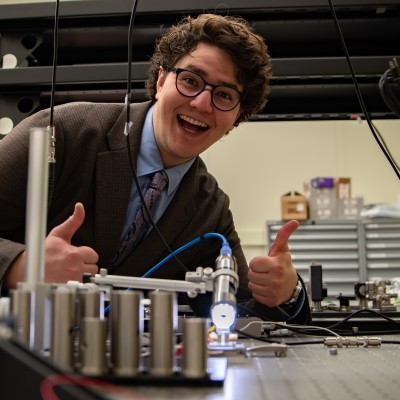
Liam G. Connolly is a Mechanical Engineer and Postdoctoral Research Fellow in the Optomechanics and Photonics group of the Microsystems and Nanotechnology division at the National Institute of Standards and Technology focused on development of new measurement and transduction systems leveraging MEMS-based acoustic resonators integrated with microscale optical cavities for quantum communications and advanced process monitoring in atomic layer deposition systems.
Liam earned his B.S. in Mechanical Engineering from Tufts University in 2016 before joining the group of Prof. Michael Cullinan at The University of Texas at Austin under an NSF Graduate Research Fellowship where he completed an M.S. and Ph.D. in Mechanical Engineering focused on precision tool design for tip-based measurement applied to in-line process control in semiconductor manufacturing. Liam joined NIST in 2022 through a National Research Council Postdoctoral Fellowship.
Previous Seminars
Roll-to-Roll NIL – The perils and promise of large-scale structured surface
Wednesday, March 18, 2026, 2:00 PM Central Time
Hosted by ASPE Micro/Nano Committee, Chairman: Michael Cullinan, UT Austin (michael.cullinan@austin.utexas.edu)
Speaker: Stephen Furst, Smart Material Solutions
Abstract:
Micro- and nanopatterned structured surfaces offer revolutionary promises to improve how everyday surfaces interact with their environment. This includes improving the surface’s interaction with matter (like water, dust, or microbes) or with light. The resulting control allows for improvements in surface reflection, light diffusion, thermal emissivity, hydrophobicity, hydrophilicity, dust adhesion, and microbial resistance, among other properties.
For decades, roll-to-roll nanoimprint lithography (R2R NIL) has offered the promise of bringing the powers of nano to the macroscale for humanity’s benefit. A google scholar search will find tens of thousands of academic articles proving these benefits. Nevertheless, the promise remains mysteriously unfulfilled.
This talk will address the perils that lie between the promise and today’s reality, and the work that Smart Material Solutions has done to close the gap. This will include lessons learned on application design, scalable manufacturing, surface durability, business models, and fundraising narratives. In the end, the opportunity of controlling large-scale surface interactions is immense, and roll-to-roll NIL has a viable and important role in capturing that opportunity.


Biography:
Dr. Stephen Furst is a Mechanical Engineer specialized in precision engineering, nanomanufacturing, and smart materials research. Stephen founded Smart Material Solutions in 2016 to commercialize Nanocoining: a technology that enables fabrication of large-area nanopatterns via roll-to-roll nanoimprint lithography, and he currently serves as the company’s CEO. Stephen previously served as a member of the Board of Directors for the American Society of Precision Engineering and the society’s Precision Manufacturing chair.
Stephen completed his BS in Aerospace Engineering at NC State in 2007, then his MS in Mechanical Engineering in 2009 under the direction of Dr. Thomas Dow at the NC State Precision Engineering Center (PEC), the lab where the Nanocoining technology was later invented. Stephen began his PhD work in 2009 with Prof. Dr. -Ing. Stefan Seelecke at NC State with emphasis on smart materials research before finishing his research and graduating from Saarland University (Saarbruecken, Germany) in 2012.
Stephen’s publications are available on Google Scholar.
Contact: furst@smartmaterialsolutions.com
919-521-4440
Precision Engineering Challenges and Capabilities of Bright Silicon Technologies’ Lightfield Directing Array (LDA)
Wednesday, February 18, 2026, 2:00 PM Central Time
Hosted by ASPE Micro/Nano Committee, Chairman: Michael Cullinan, UT Austin
Speaker: Robert Panas, Bright Silicon Technologies
Abstract:
Robert Panas will be introducing the precision engineering challenges and capabilities of the flagship product for Bright Silicon Technologies, the Lightfield Directing Array (LDA). The LDA is a new class of solid-state optical beam control technology that offers the large range of motion and high optical quality of a gimbal combined with the speed of a fast-steering mirror, in a low-Size, Weight, and Power (SWaP) package. The LDA combines conventional microelectromechanical systems (MEMS) elements with advanced fabrication techniques to achieve performance beyond established and emerging beam control technologies.


Biography:
Robert Panas is the CTO at Bright Silicon Technologies (BST), a startup focused on maturing a solid-state optical beamsteering technology called the Lightfield Directing Array, which was spun out from Lawrence Livermore National Laboratory (LLNL). He started in March 2022 after working as a research engineer at LLNL for 8 years in the Center for Micro-Nano Technologies, where he led a team developing the LDA technology. Robert graduated from the Massachusetts Institute of Technology with a S.B. in physics (’07), a S.B. in Mechanical Engineering (’07), a M.S. in Mechanical Engineering (’09) and a PhD in Mechanical Engineering (’13). Robert leads precision micro/nano design and manufacturing efforts at BST, focused on developing the electronics, controls and manufacturing capabilities required to enable the LDA. His areas of expertise include MOEMS, additive micromanufacturing, optics, X-ray metrology, uncertainty analysis, compliant mechanism design, and high-speed digital control. Dr. Panas is an NDSEG fellow and a member of the American Society for Precision Engineering (ASPE) since 2007, now the immediate past President for the society having served on the: Organizing Committee (2013, 2014), Membership Committee (2013, 2014), Co-chair Precision Engineering Challenge (2014), Chair Precision Engineering Challenge (2015), Chair MNTLC (2016-2020) and the Board of Directors (2017-2020), and executive committee as President Elect (2022), President (2023), and Immediate Past President (2024). He has 34 patents and applications as well as 87 papers published and submitted.